
Roulette
- Rules of play against a casino
- Roulette wheel number sequence
- Types of bets
- House edge
- Traditional roulette wheel sectors
- Pros and Cons of the Roulette Casino Game
- How to Rate Casinos: A Guide for Informed Evaluation
- How to Play Roulette in Casinos: A Step-by-Step Guide
- Notable winnings
- FAQ: Roulette Casino Game
Roulette (named after the French word meaning “little wheel”) is a casino game which was likely developed from the Italian game Biribi. In the game, a player may choose to place a bet on a single number, various groupings of numbers, the colour red or black, whether the number is odd or even, or if the number is high or low.
To determine the winning number, a croupier spins a wheel in one direction, then spins a ball in the opposite direction around a tilted circular track running around the outer edge of the wheel. The ball eventually loses momentum, passes through an area of deflectors, and falls onto the wheel and into one of the colored and numbered pockets on the wheel. The winnings are then paid to anyone who has placed a successful bet.
Rules of play against a casino
Roulette players have a variety of betting options. “Inside” bets involve selecting either the exact number on which the ball will land, or a small group of numbers adjacent to each other on the layout. “Outside” bets, by contrast, allow players to select a larger group of numbers based on properties such as their color or parity (odd/even). The payout odds for each type of bet are based on its probability.
The roulette table usually imposes minimum and maximum bets, and these rules usually apply separately for all of a player’s inside and outside bets for each spin. For inside bets at roulette tables, some casinos may use separate roulette table chips of various colors to distinguish players at the table. Players can continue to place bets as the ball spins around the wheel until the dealer announces “no more bets” or “rien ne va plus”.
When a winning number and colour is determined by the roulette wheel, the dealer will place a marker, also known as a dolly, on that number on the roulette table layout. When the dolly is on the table, no players may place bets, collect bets or remove any bets from the table. The dealer will then sweep away all losing bets either by hand or by rake, and determine the payouts for the remaining inside and outside winning bets. When the dealer is finished making payouts, the dolly is removed from the board, and players may collect their winnings and make new bets. Winning chips remain on the board until picked up by a player.
Roulette wheel number sequence
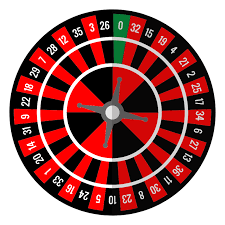
The pockets of the roulette wheel are numbered from 0 to 36.
In number ranges from 1 to 10 and 19 to 28, odd numbers are red and even are black. In ranges from 11 to 18 and 29 to 36, odd numbers are black and even are red.
There is a green pocket numbered 0 (zero). In American roulette, there is a second green pocket marked 00. Pocket number order on the roulette wheel adheres to the following clockwise sequence in most casinos:
- Single-zero wheel
0-32-15-19-4-21-2-25-17-34-6-27-13-36-11-30-8-23-10-5-24-16-33-1-20-14-31-9-22-18-29-7-28-12-35-3-26
- Double-zero wheel
0-28-9-26-30-11-7-20-32-17-5-22-34-15-3-24-36-13-1-00-27-10-25-29-12-8-19-31-18-6-21-33-16-4-23-35-14-2
- Triple-zero wheel
0-000-00-32-15-19-4-21-2-25-17-34-6-27-13-36-11-30-8-23-10-5-24-16-33-1-20-14-31-9-22-18-29-7-28-12-35-3-26
Types of bets
In roulette, bets can be either inside or outside.
Inside bets
| Name | Description | Chip placement |
|---|---|---|
| Straight/single | Bet on a single number | Entirely within the square for the chosen number |
| Split | Bet on two vertically/horizontally adjacent numbers (e.g. 14-17 or 8–9) | On the edge shared by the numbers |
| Street | Bet on three consecutive numbers in a horizontal line (e.g. 7-8-9) | On the outer edge of the number at either end of the line |
| Corner/square | Bet on four numbers that meet at one corner (e.g. 10-11-13-14) | On the common corner |
| Six line/double street | Bet on six consecutive numbers that form two horizontal lines (e.g. 31-32-33-34-35-36) | On the outer corner shared by the two leftmost or the two rightmost numbers |
| Trio/basket | A three-number bet that involves at least one zero: 0-1-2 (either layout); 0-2-3 (single-zero only); 0-00-2 and 00-2-3 (double-zero only) | On the corner shared by the three chosen numbers |
| First four | Bet on 0-1-2-3 (single-zero layout only) | On the outer corner shared by 0-1 or 0-3 |
| Top line | Bet on 0-00-1-2-3 (double-zero layout only) | On the outer corner shared by 0-1 or 00-3 |
Outside bets
Outside bets typically have smaller payouts with better odds at winning. Except as noted, all of these bets lose if a zero comes up.
- 1 to 18 (low or manque), or 19 to 36 (high or passe)
A bet that the number will be in the chosen range.
- Red or black (rouge ou noir)
A bet that the number will be the chosen color.
- Even or odd (pair ou impair)
A bet that the number will be of the chosen parity.
- Dozen bet
A bet that the number will be in the chosen dozen: first (1-12, Première douzaine or P12), second (13-24, Moyenne douzaine or M12), or third (25-36, Dernière douzaine or D12).
- Column bet
A bet that the number will be in the chosen vertical column of 12 numbers, such as 1-4-7-10 on down to 34. The chip is placed in the space below the final number in this sequence.
- Snake bet
A special bet that covers the numbers 1, 5, 9, 12, 14, 16, 19, 23, 27, 30, 32, and 34. It has the same payout as the dozen bet and takes its name from the zig-zagging, snakelike pattern traced out by these numbers. The snake bet is not available in all casinos; when it is allowed, the chip is placed on the lower corner of the 34 square that borders the 19-36 betting box. Some layouts mark the bet with a two-headed snake that winds from 1 to 34, and the bet can be placed on the head at either end of the body.
In the United Kingdom, the farthest outside bets (low/high, red/black, even/odd) result in the player losing only half of their bet if a zero comes up.
House edge
The house average or house edge or house advantage (also called the expected value) is the amount the player loses relative to any bet made, on average. If a player bets on a single number in the American game there is a probability of 1⁄38 that the player wins 35 times the bet, and a 37⁄38 chance that the player loses their bet. The expected value is:
−1 × 37⁄38 + 35 × 1⁄38 = −0.0526 (5.26% house edge)
For European roulette, a single number wins 1⁄37 and loses 36⁄37:
−1 × 36⁄37 + 35 × 1⁄37 = −0.0270 (2.70% house edge)
For triple-zero wheels, a single number wins 1⁄39 and loses 38⁄39:
−1 × 38⁄39 + 35 × 1⁄39 = −0.0769 (7.69% house edge)
Traditional roulette wheel sectors
Although most often named “call bets” technically these bets are more accurately referred to as “announced bets”. The legal distinction between a “call bet” and an “announced bet” is that a “call bet” is a bet called by the player without placing any money on the table to cover the cost of the bet. In many jurisdictions (most notably the United Kingdom) this is considered gambling on credit and is illegal. An “announced bet” is a bet called by the player for which they immediately place enough money to cover the amount of the bet on the table, prior to the outcome of the spin or hand in progress being known.
There are different number series in roulette that have special names attached to them. Most commonly these bets are known as “the French bets” and each covers a section of the wheel. For the sake of accuracy, zero spiel, although explained below, is not a French bet, it is more accurately “the German bet”. Players at a table may bet a set amount per series (or multiples of that amount). The series is based on the way certain numbers lie next to each other on the roulette wheel. Not all casinos offer these bets, and some may offer additional bets or variations on these.
Pros and Cons of the Roulette Casino Game
Pros
- + Simple Rules: Easy to learn and play, making it suitable for beginners and experienced players alike.
- + Variety of Betting Options: Offers a range of bets, from single numbers to groups, allowing players to customize risk.
- + Wide Availability: Found in almost every casino, both online and offline.
- + Entertaining Gameplay: The spinning wheel and anticipation add excitement.
- + Flexible Stakes: Accommodates various budgets, from low minimums to high limits.
- + Social Interaction: Often played in a lively environment, creating opportunities for socializing.
Cons
- − High House Edge: Depending on the variation, the house edge can be significant.
- − Luck-Based Game: Completely reliant on chance, with no strategy to influence outcomes.
- − Risk of Fast Losses: Quick gameplay can lead to rapid depletion of bankroll.
- − Complex Odds: Payouts can confuse new players, especially with combination bets.
- − Addictive Nature: The thrill and quick outcomes may lead to compulsive gambling.
- − Limited Skill Factor: Offers no scope for skill development or strategic improvement.
Pros
- Simple Rules: Easy to learn and play, making it suitable for beginners and experienced players alike.
- Variety of Betting Options: Offers a range of bets, from single numbers to odds/even, red/black, and groupings, allowing players to customize their risk level.
- Wide Availability: Found in almost every casino, both online and offline, providing easy access.
- Entertaining Gameplay: The spinning wheel and anticipation add excitement, making it a crowd favourite.
- Flexible Stakes: Accommodates various budgets, with low minimum bets and high limits for high rollers.
- Social Interaction: Often played in a lively environment, creating opportunities for socializing.
Cons
- High House Edge: Depending on the variation (e.g., American Roulette with double zero), the house edge can be significant, reducing long-term winning potential.
- Luck-Based Game: Completely reliant on chance, with no strategy to influence outcomes.
- Risk of Fast Losses: Quick gameplay can lead to rapid depletion of bankroll if not managed carefully.
- Complex Odds: While the game seems simple, the odds and payouts can confuse new players, especially with combination bets.
- Addictive Nature: The thrill of the wheel and quick outcomes may lead to compulsive gambling tendencies.
- Limited Skill Factor: Unlike poker or blackjack, it offers no scope for skill development or strategic improvement.
How to Rate Casinos: A Guide for Informed Evaluation
Rating a casino requires considering several factors that impact gameplay, user experience, and trustworthiness. This process ensures that players engage with platforms that prioritize safety, fairness, and entertainment. Below is a list of key criteria to assess when rating casinos.
- Licensing and Regulation Verify if the casino is licensed by reputable authorities (e.g., Malta Gaming Authority, UK Gambling Commission). Proper regulation ensures the platform adheres to strict standards.
- Game Selection Evaluate the variety and quality of games available, including slots, table games like roulette, and live dealer options. A wide selection indicates a platform catering to diverse preferences.
- Security Measures Ensure the site uses advanced encryption (e.g., SSL) to protect user data and financial transactions. Security certifications are a must.
- Bonuses and Promotions Check the welcome bonuses, ongoing promotions, and loyalty programs. Pay attention to wagering requirements and bonus terms.
- Payment Options Assess the availability of deposit and withdrawal methods. Look for popular options like credit cards, e-wallets, and cryptocurrencies with reasonable processing times.
- User Experience (UX) Rate the website’s design, navigation, and mobile compatibility. A user-friendly interface enhances overall satisfaction.
- Customer Support Test the responsiveness of support channels like live chat, email, or phone. Availability 24/7 is a plus.
- Reputation and Reviews Research player feedback and third-party reviews. A casino with positive ratings and a strong reputation is more reliable.
- Payout Speed Examine withdrawal processing times. Faster payouts reflect efficient operations and player-centric services.
- Fairness and RNG Certification Ensure games use certified Random Number Generators (RNGs) for fair outcomes. Independent audits (e.g., eCOGRA) add credibility.
How to Play Roulette in Casinos: A Step-by-Step Guide
Roulette is a timeless casino classic, offering simple gameplay and exciting betting options. To enjoy this game responsibly and maximize your experience, follow these steps:
- Find a Reputable Casino. Choose a licensed and trusted casino to ensure fair play and secure transactions. Use our expert recommendations to simplify your search.
- Understand the Table Layout. Familiarize yourself with the roulette table, which includes the wheel, numbered betting grid, and betting areas for inside and outside bets.
- Select a Roulette Variation. Choose from popular versions such as European, American, or French roulette. Each has unique features and odds; European roulette is favoured for its lower house edge.
- Set a Budget. Decide your bankroll and stick to it. This ensures responsible gaming and prevents unnecessary losses.
- Place Your Bets. Choose your chips and place them on your preferred betting options. Inside bets focus on individual numbers or small groups, while outside bets cover broader categories like red/black or odd/even.
- Watch the Spin. Once bets are placed, the dealer spins the wheel and rolls the ball. Enjoy the anticipation as the ball lands on a number.
- Check the Results. Winning bets are announced, and payouts are made. Unsuccessful bets are collected by the house.
- Decide Your Next Move. Continue betting, adjust your strategy, or walk away with your winnings. Playing responsibly is key to enjoying the game.
Quotes:
- Albert Einstein: “You cannot beat a roulette table unless you steal money from it.”
- George Bernard Shaw: “The roulette table pays nobody except him that keeps it. Nevertheless, a passion for gaming is common, though a passion for keeping roulette tables is unknown.
- Steven Wright: “In Vegas, I got into a long argument with the man at the roulette wheel over what I considered to be an odd number.”
Notable winnings
- In the 1960s and early 1970s, Richard Jarecki won about $1.2 million at dozens of European casinos. He claimed that he was using a mathematical system designed on a powerful computer. In reality, he simply observed more than 10,000 spins of each roulette wheel to determine flaws in the wheels. Eventually the casinos realized that flaws in the wheels could be exploited and replaced older wheels. The manufacture of roulette wheels has improved over time.
- In 1963, Sean Connery, filming From Russia with Love in Italy, attended the casino in Saint-Vincent and won three consecutive times on the number 17, his winnings riding on the second and third spins.
- In 2004, Ashley Revell of London sold all of his possessions, clothing included, and placed his entire net worth of US$135,300 on red at the Plaza Hotel in Las Vegas. The ball landed on “Red 7” and Revell walked away with $270,600.
FAQ: Roulette Casino Game
- What are the main types of roulette? European, American, and French roulette. European has one zero, American has double zero, and French includes special rules like La Partage for better odds.
- Is roulette a skill-based game? No, roulette is purely a game of chance. Outcomes are determined by a random spin of the wheel and ball.
- What is the house edge in roulette? European roulette: 2.7%, American roulette: 5.26%. The house edge depends on the variation and rules.
- Can I use strategies to win at roulette? Strategies like Martingale manage bets but don’t guarantee wins. Roulette outcomes remain unpredictable.
- Are online roulette games fair? Licensed casinos use certified RNGs (Random Number Generators) to ensure fair and unbiased results. Always choose reputable platforms.